

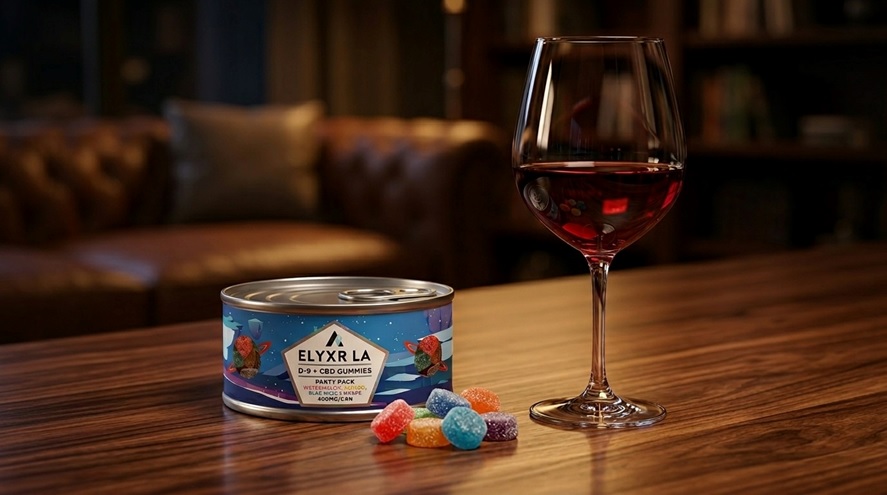
Pour a glass of red wine or chew a Delta-9 gummy. Both have become standard evening wind-down rituals for adults trying to slow down at the end of the day.
Same goal. Very different chemistry, very different next morning.
Here is the head-to-head comparison that matters: sleep quality, calories, hangover, mood, long-term health risk, and the social factor. By the end you will know which tool belongs in your evening, or whether you should rotate them.
Sleep Quality
Alcohol disrupts REM sleep. Even one glass can shorten your dream cycles and produce shallower rest.
Delta-9 gummies tend to support deeper sleep, especially blends with CBN.
Many users who switch from a nightly wine habit to a low-dose nightly gummy report waking up more rested within two weeks.
If your goal is sleep quality, the gummy wins clearly.
Calories
A 5-ounce glass of red wine carries about 125 calories.
A 10-milligram Delta-9 gummy carries 10 to 30 calories depending on whether it is sugar-based or sugar-free.
Two glasses of wine a night equals 250 calories. Two gummies equals 20 to 60.
Over a year, that math becomes significant. Roughly 90,000 calories a year of difference at the two-drink mark.
For users tracking weight, body composition, or blood sugar, the gummy wins on calories alone.
Hangover and Next-Morning Function
One or two glasses of red wine often produces a mild hangover the next day. Three or more guarantees it.
Delta-9 gummies rarely produce a hangover at moderate doses. High doses (25 mg and up) can leave a soft fog in the morning, but nothing close to the alcohol experience.
If you have an early meeting, the gummy is the smarter pick.
If you sleep in and have no obligations, either tool can work.
Mood and Emotion
Alcohol is a depressant. Mood lift in the first thirty minutes often gives way to flatter mood after the second drink.
Delta-9 produces a more nuanced mood lift, especially in lower doses. Many users report a calm, contented feeling rather than the wired-then-flat alcohol arc.
On the other hand, alcohol is more familiar in social settings. Gummies can be harder to predict if you are new to them.
Bottom line. For solo evenings, the gummy wins on mood quality. For social events you know well, wine might still feel right.
Long-Term Health Profile
Regular alcohol use has well-documented effects on the liver, cardiovascular system, and cancer risk.
Cannabinoid use does not have the same long-term study base, but the published evidence so far suggests a much lower physical health risk profile.
Daily wine over decades carries clear health costs. Daily moderate Delta-9 use over decades is less well studied but appears to carry fewer physical risks.
Sugar-free Delta-9 gummies eliminate the sugar load of regular gummies. If you want a long-term-friendly format, look for sugar-free Delta-9 gummies that use allulose or stevia rather than cane sugar.
Social and Lifestyle Considerations
Wine is socially universal. Bringing a bottle to dinner is normal.
Gummies are still a personal product. Most people do not eat them at a dinner party.
Smell is a wash. Both wear off without lingering smell.
Travel: gummies fly easier inside the United States than wine bottles do.
Cost per evening: a moderate wine habit costs ten to twenty dollars a week. A low-dose gummy habit costs three to seven dollars a week.
When to Pick Each One
Pick the gummy on weeknights, sleep-priority nights, calorie-conscious phases, and any evening you have to drive later or wake up early.
Pick wine on social nights you have committed to, when food and conversation are the centerpiece, and when you have plenty of buffer the next morning.
Rotate them if neither extreme appeals. Three gummy nights and one wine night per week works for many users.
If you are cutting back on alcohol, the gummy is a structured replacement that does not feel like abstinence.
Sample One-Month Switch Plan
Week 1: Replace your weekday wine with a 5 mg Delta-9 gummy. Keep weekend wine as usual.
Week 2: Add a 5 mg gummy on Friday and Saturday. Cut weekend wine in half.
Week 3: Stay at one or two gummies a day for five nights. Eliminate wine entirely on weekdays.
Week 4: Test a full month of gummy-only evenings.
Reassess at the end of week 4. Decide whether to return to wine or stick with gummies based on sleep, mood, and weight.
Final Word
Delta-9 gummies and red wine each have a role in adult social and wind-down culture. They are not equivalent products.
The gummy wins on sleep, calories, hangover, and long-term health profile. Wine wins on social familiarity and food pairing.
Try a one-month switch if your wine habit has crept beyond what feels healthy. Most users sleep better, feel better, and save money.
Frequently Asked Questions
Q. Can I mix wine and a gummy in the same evening?
Possible but unpredictable. Effects can stack heavier than expected.
Q. Will a 10 mg gummy match the effect of a glass of wine?
Roughly, for most users. Both produce mild relaxation.
Q. How long does a gummy last compared to wine?
Gummies last four to six hours of effect. Wine peaks at one hour and fades within two to three.
Q. Do gummies count as drinking?
Not legally, but social context varies.
Q. Are gummies safer for blood pressure?
Most studies suggest yes at low doses, though individual results vary.
Q. Will I dream more on gummies?
Many users report richer dreams on cannabis nights, especially when combined with CBN.
Final Word
Wine has a long social history. Delta-9 gummies are the modern alternative for a specific evening problem: slowing down without the alcohol cost.
If your wine habit has crept up to four or five glasses a week and you want a way to scale it back, gummies are the most realistic substitute available.
Try a one-month switch. Most users sleep better, lose a couple of pounds, and stop dreading their Monday mornings. If the experiment fails, the wine is still there. Either way, you learn what works.
